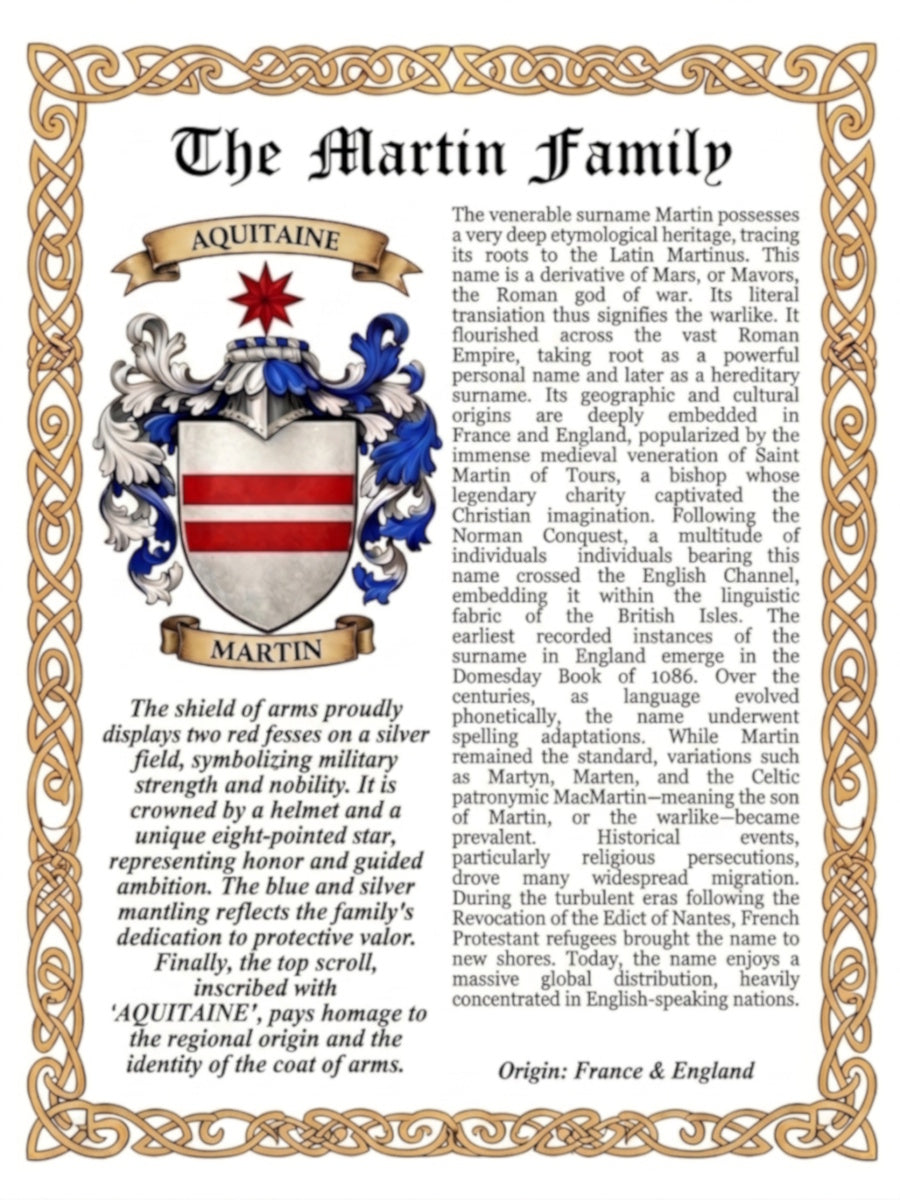
As one of the most widely recognized and frequently encountered surnames in the world, Martin is a name that bridges ancient mythology, medieval religion, aristocratic lineages, and global exploration. Today, it ranks as the most common surname in France, a top twenty name in the United States and the United Kingdom, and boasts a massive presence in Spain, Canada, and Australia.
However, tracing the roots of the Martin surname is not a simple straight line. It is a polygenetic name—meaning it emerged independently in various places at different times. Because of this, the history of the Martin name is filled with fascinating, and sometimes conflicting, origin stories. Let’s dive into the epic history of the Martin surname, exploring its martial roots, its saintly transformation, and the complex genealogical webs that define it today.
The Etymological Conflict: Roman Gods vs. Germanic Tribes
If you look at the root of the name Martin, you immediately encounter a linguistic conflict. Where exactly did the word come from?
The most widely accepted origin of the name lies in the classical Roman era. Etymologists trace Martin to the Latin personal name "Martinus," which is a derivative of "Mars." In Roman mythology, Mars was the fierce god of war and agricultural fertility. Therefore, the literal translation of the name Martinus is "of Mars," "martial," or "warlike." In the Roman Empire, giving a child a theophoric name like Martinus was a way to invoke the protection and martial prowess of the deity.
However, there is a conflicting theory regarding a Proto-Germanic origin. Some linguistic scholars argue that the name is a fusion of the ancient Germanic elements "mar" (meaning famous or illustrious) and "tank" (meaning thought or counsel). Others suggest the root "mar" translates to "to gleam" or "to shine."
Why do these origins conflict? The answer lies in the chaotic linguistic layering of Europe during the Migration Period. As the Roman Empire collapsed and Germanic tribes swept across the continent, Roman and Germanic cultures heavily intermingled. While it is highly probable that the Roman "Mars" is the true anchor of the name, the existence of similar-sounding Germanic roots means that in certain regions of Northern Europe, the name may have evolved from tribal descriptors of wisdom and fame rather than Roman militarism.
The Irony of Saint Martin: From War to Peace
Regardless of whether its roots lay in Roman war or Germanic wisdom, the name Martin owes its explosive global popularity to a single, radically pacifist historical figure: Saint Martin of Tours.
Born in the fourth century in Pannonia (modern-day Hungary), Martin was the son of a Roman military tribune and was forced into the Roman cavalry. While stationed in Amiens, Gaul (modern-day France), he experienced an event that changed history. According to legend, Martin encountered a freezing beggar at the city gates. Drawing his military sword, he sliced his heavy cavalry cloak in half and gave one piece to the beggar. That night, Martin had a vision of Jesus Christ wearing the torn cloak. This catalyzed his conversion to Christianity; he famously laid down his weapons, declaring he was a soldier of Christ and could no longer fight.
Saint Martin went on to become the Bishop of Tours, founding some of the earliest monasteries in Europe. Because of his legendary charity, he became one of the most venerated saints of the Middle Ages. Parents across Europe began naming their children Martin in hopes of securing the saint's patronage. In a beautiful twist of historical irony, a name etymologically meaning "warlike" became universally associated with Christian mercy and pacifism.
The English Conflict: Patronymic vs. Toponymic
In the British Isles, the Martin surname introduces another fascinating genealogical conflict: the difference between patronymic and toponymic origins.
The name Martin was virtually unknown in England until the Norman Conquest of 1066. The invading Normans, who heavily venerated Saint Martin, brought the name across the English Channel. A famous figure from this era was Martin de Tours, a Norman knight who fought alongside William the Conqueror and was granted vast lands in Wales, establishing the Palatine Barony of Cemaes. His descendants, initially known as "FitzMartin" (son of Martin), eventually shortened their surname to Martin, seeding the name throughout the English aristocracy and gentry.
However, genealogists researching English Martins often hit a conflicting wall. Not all English Martins descend from Norman nobility. During the Middle Ages, as taxation required commoners to adopt fixed last names, many rural English peasants took "toponymic" surnames based on the towns they lived in. There were several English towns named "Merton." Over generations, due to phonetic shifts and spelling variations by regional clerks, the surname Merton evolved and was recorded as "Martin."
This creates a brilliant conflict for modern researchers: an English person named Martin today might be the descendant of a fierce Norman lord, or they might simply be the descendant of an Anglo-Saxon farmer who happened to live in a village called Merton!
The Celtic Fringe: The Deep Divide in Ireland
Perhaps nowhere is the conflict of the Martin origins more pronounced than in Ireland, where two entirely distinct, unrelated bloodlines collided to create the modern Irish Martin population.
On one hand, you have the famous "Tribes of Galway." These were fourteen powerful merchant families of Anglo-Norman descent who dominated the political and commercial life of Galway city for centuries. The Martins of Galway claim descent from Sir Oliver Martyn, a crusader who supposedly arrived in Ireland during the Norman invasion of 1172. These Martins were wealthy landowners and builders, famous for constructing Martin's Mill and producing notable figures like Richard "Humanity Dick" Martin, a legendary duelist who paradoxically founded the Society for the Prevention of Cruelty to Animals.
On the other hand, there is a purely indigenous, Gaelic origin for the name. In the northern province of Ulster, specifically in County Tyrone, lived the ancient Gaelic sept known as Mac Giolla Mhartain, which translates to "son of the follower of Saint Martin." Following seventeenth-century land confiscations, these Gaelic families were forced westward into Sligo and Leitrim. Over time, under British rule, their complex Gaelic name was anglicized, stripped of its "Mac," and translated simply to "Martin" or "Gilmartin."
This presents a massive conflict for the Irish diaspora. Two Irishmen named Martin could stand side by side today; one might carry the blood of Anglo-Norman invaders who built castles in Galway, while the other carries the blood of ancient Gaelic chieftains from Tyrone. Because the names were Anglicized to look identical, untangling these roots requires deep, localized genealogical research.
Global Expansion and the New World
As the centuries progressed, religious upheaval and colonial expansion pushed the Martin name to the corners of the earth. In Spain, the patronymic "Martínez" (son of Martin) exploded in popularity. Interestingly, during the Spanish Inquisition, many Sephardic Jews who were forced to convert to Christianity (Conversos) adopted the surname Martín or Martínez as a Christianized version of the Hebrew name Mordecai, adding a rich layer of Jewish heritage to the Spanish Martin lineage.
When the Age of Discovery dawned, Martins were among the first to brave the Atlantic. In 1607, Captain John Martin arrived in Virginia on the ship Discovery to help found Jamestown. In 1620, Christopher Martin served as a signatory of the Mayflower Compact. Meanwhile, French Martins like Pierre and Abraham Martin were pioneering the harsh frontiers of Acadia and Quebec in Canada. Later, the tragic Highland Clearances in Scotland—which displaced the fierce MacMartins of Clan Cameron—and the devastation of the Irish Potato Famine sent massive waves of Celtic Martins to the shores of the United States, Australia, and New Zealand.
The Symbols of a Legacy
For those branches of the family that were granted a coat of arms, heraldic symbols offer a glimpse into the values of their ancestors. While no single crest represents all Martins, common themes persist. Red (Gules) is frequently used to symbolize martial strength and martyrdom, harkening back to the name's Roman roots. Blue (Azure) signifies loyalty and truth. The standing (rampant) lion is a popular charge, representing bravery, while the cross reflects the family's deep ties to the Christian crusades and Saint Martin himself. Many bear the proud Latin motto, Auxilium meum a Domino—"My help is from the Lord."
Conclusion
To carry the surname Martin is to bear a name of incredible duality. It is a name born from the pagan Roman God of War, yet immortalized by a pacifist Christian saint. It is the name of Norman conquerors and humble English villagers, of aristocratic Galway merchants and displaced Gaelic chieftains. Through the centuries, the Martins have been soldiers and saints, pioneers and poets. The conflicting origins of the name are not a flaw in its history, but rather a testament to its universal appeal—a name so powerful and enduring that diverse cultures across the globe all claimed it as their own.