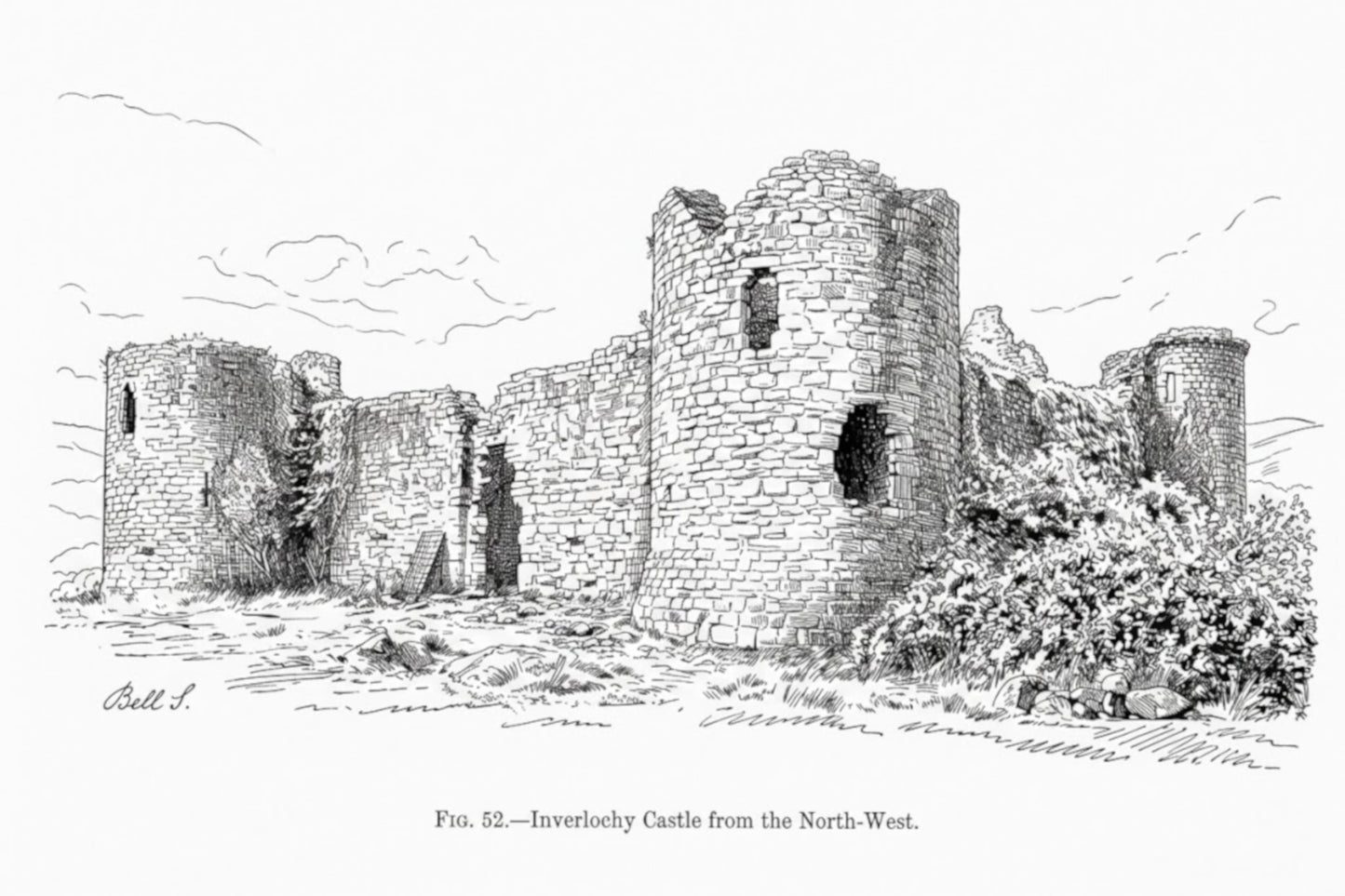
The Scottish Highlands are renowned for their rugged, breath-taking landscapes and a history soaked in romance, clan warfare, and royal intrigue. Yet, few locations encapsulate the sheer duality of Scotland’s dramatic past quite like Inverlochy. Nestled in the lush, verdant foothills of the mighty Ben Nevis, just a few miles from the bustling Highland town of Fort

William, Inverlochy is not merely a single historic site. It is a tale of two entirely distinct castles
—one a formidable medieval fortress scarred by centuries of bloody conflict, and the other a lavish nineteenth-century baronial mansion that has evolved into one of the world's most prestigious luxury hotels. Together, they tell a magnificent 800-year story of power, survival, and unparalleled Highland hospitality.
Purchase a Digital Copy of this poster - https://fairbairncrests.com/products/inverlochy-castle-poster-historic-13th-century-fortress-high-resolution-digital-download
The Ancient Sentinel of the Great Glen
To understand the origins of Inverlochy, one must first look to the unique geography of the Great Glen. This massive geological fault line slices through the Highlands, serving as a vital artery for travel, trade, and military movement for thousands of years. The mouth of the River Lochy, where the waters flow into Loch Linnhe, was the perfect strategic chokepoint to control access between the western islands and the northern inland territories.
Long before stone walls were raised, this site was a coveted prize. According to sixteenth-century historian Hector Boece, a significant Pictish settlement—perhaps even a thriving "city"—once occupied this very ground before being entirely decimated by Viking invaders. However, the physical legacy of Inverlochy truly began to take shape between 1270 and 1280.
It was during this period that John "the Black" Comyn, Lord of Badenoch and Lochaber, erected the magnificent stone fortress we now refer to as Old Inverlochy Castle. At the time, the Comyns were arguably the most powerful family in all of Scotland, holding vast estates and wielding immense political influence. John the Black Comyn even served as a Guardian of Scotland following the death of King Alexander III.
Old Inverlochy was a masterpiece of medieval military engineering. Classified as a castle of enceinte, its primary defence was not a central keep, but a massive, continuous curtain wall measuring up to nearly 10 feet thick and 25 feet high. The quadrangular courtyard was flanked by four round towers. The largest of these, situated at the northwest corner, was known as the Comyn Tower; measuring 20 feet across its interior, it served as the lord’s private residence and the ultimate sanctuary during a siege. Surrounded on three sides by a wide, water-filled moat and guarded on the fourth by the River Lochy, the castle featured a heavily defended main gate and a northern "water gate" designed to allow West Highland galleys to deliver supplies and troops directly from the sea.
Blood, Betrayal, and the Wrath of the Bruce
The Comyns’ dominance, however, was destined for a violent end. The family found themselves in a bitter rivalry with Robert the Bruce over the claim to the Scottish throne. This feud reached a bloody climax in February 1306, when Bruce murdered John "the Red" Comyn—the son of Inverlochy’s builder—before the altar of Greyfriars Church in Dumfries.
Having committed profound sacrilege, Bruce seized the throne and sparked a brutal civil war, making the total annihilation of the Comyn family his top priority. Following his victory at the Battle of Inverurie in 1308, Bruce’s forces swept through the Highlands. Inverlochy Castle was captured, put to the torch, and left abandoned. The Comyn lands were subsequently stripped away and redistributed to Bruce’s loyal supporters, effectively erasing the family from the highest echelons of Scottish power.
The Two Great Battles of Inverlochy
Though the castle lay in ruins for long stretches of its history, its strategic location ensured it would serve as the backdrop for two of the most significant battles in Highland history.
The First Battle of Inverlochy erupted in 1431. King James I, determined to crush the independent power of the MacDonald Lords of the Isles, sent a massive royal army commanded by the Earls of Mar and Caithness to occupy the castle. They were ambushed by a much smaller rebel force of around 800 MacDonald clansmen led by Donald Balloch and Alasdair Carrach. The royalists suffered a humiliating and catastrophic defeat, losing some 900 men. The Earl of Caithness was killed, and the Earl of Mar barely escaped into the mountains, returning home barefoot and half-naked.
Over two centuries later, the Second Battle of Inverlochy took place in the freezing winter of February 1645. This clash was a defining moment of the Wars of the Three Kingdoms. A Covenanter army of 3,000 men, led by the Earl of Argyll (Chief of Clan Campbell), was encamped beneath the castle walls. In a stroke of tactical genius, the Royalist commander, the Marquis of Montrose, marched his Highlander and Irish forces through the snow-choked mountains to launch a devastating surprise attack. The Campbells were routed and brutally massacred, a victory famously observed and celebrated in verse by the Gaelic bard Ian Lom MacDonald, who watched the slaughter unfold from the branches of a nearby tree.
As military technology advanced, medieval fortresses became obsolete. By 1654, Oliver Cromwell’s forces bypassed Inverlochy to build a timber fort nearby, which was later replaced in 1690 by the stone structure of Fort William. Old Inverlochy was left to gracefully decay, miraculously escaping modern alterations. Today, under the care of Historic Environment Scotland, it remains one of the most complete and unaltered thirteenth-century castles in the country.
The Baronial Revival: A New Castle Rises
While the ancient ruins slumbered, a new chapter in the Inverlochy story began two miles to the northwest. In the nineteenth century, the vast 42,000-acre estate was purchased by the Scarlett family. In 1863, William Frederick Scarlett, the 3rd Baron Abinger and a decorated veteran of the Crimean War, commissioned London architect George Hesketh to build a spectacular new mansion.
This new "Inverlochy Castle" was a triumph of the Scots Baronial style, complete with asymmetric turrets, crenellated battlements, and corbiestepped gables. Later extended in 1889 by architect MacVicar Anderson to include state-of-the-art Victorian conveniences like electric lighting and hot water, the mansion was designed for opulent hosting.
The Victorian era saw a massive surge of aristocratic interest in the Scottish Highlands, largely driven by Queen Victoria’s love for the region. In 1873, the Queen chose to spend a week at the newly built Inverlochy Castle rather than her usual retreat at Balmoral. She spent her days sketching the breathtaking views of Ben Nevis and the surrounding glens, famously writing in her diary, "I never saw a lovelier or more romantic spot." This royal endorsement cemented the estate's reputation, attracting a glittering array of guests over the decades.
From Cattle Ranch to Five-Star Luxury
The Scarlett family enjoyed the estate for nearly a century before selling it in 1944 to Joseph Hobbs, a Canadian entrepreneur and owner of the nearby Ben Nevis Distillery. Hobbs remarkably transformed the estate into the "Great Glen Cattle Ranch," introducing a large herd of Aberdeen Angus cattle to the property. However, it was his son, Joe Hobbs Jr., and his Danish wife, Grete, who recognised the property's true potential. In 1969, they opened the doors of their grand home to the public, transforming the baronial mansion into a country house hotel.
The hotel was an instant sensation, named Britain’s number one hotel by Egon Ronay by 1971. Today, Inverlochy Castle Hotel is celebrated as one of the finest luxury hotels in the world, having hosted luminaries ranging from Queen Elizabeth II and Prince Philip to Sean Connery, Elton John, and Robert De Niro.
Stepping into the hotel today is like stepping back into a world of unbridled aristocratic elegance. The Great Hall boasts Venetian crystal chandeliers and a breathtaking Michelangelo-style frescoed ceiling. The 17 bedrooms and suites are individual masterpieces of design, featuring Peter Reed 400-thread-count Egyptian cotton linens, Penhaligon's toiletries, and flat-screen televisions disguised as gilded mirrors.
A Culinary Destination
No modern history of Inverlochy is complete without mentioning its culinary legacy. For decades, the castle's kitchens have been associated with the highest echelons of gastronomy, previously holding a Michelin star for many years and currently boasting 3 AA Rosettes. Today, the dining experience is overseen by the legendary two-Michelin-starred chef Michel Roux Jr.
The restaurant, appropriately named Seasgair (Gaelic for "warm and comfortable"), offers an unforgettable journey through the Scottish larder. Guests begin their evening with Champagne and canapés by the roaring fire in the Great Hall, accompanied by live piano music. They are then treated to a five-course tasting menu featuring hyperlocal ingredients, from Hebridean salmon to wild estate venison. For a truly immersive experience, guests can dine at the "Mary Shaw Table" in the Library—named after the castle's original Victorian cook—where diners can share their meal as a group in the spirit of a traditional country house party.
From the blood-soaked stones of a thirteenth-century fortress to the crystal-draped halls of a Victorian luxury hotel, the dual legacy of Inverlochy is a magnificent reflection of Scotland itself. It is a place where ancient warriors and modern royalty have both left their mark, standing defiant and beautiful beneath the shadow of Ben Nevis.
--------------------------------------------------------------------------------
References
Celtic Castles. (n.d.). Inverlochy Castle Hotel - 5 Star Luxury Castle Hotel in the Scottish Highlands.
Elysian Estates. (n.d.). Wish Upon a (Michelin) Star: Scottish Fine Dining at Inverlochy Castle.
Great Castles. (n.d.). Inverlochy Castle.
Historic Environment Scotland. (n.d.). Baronial Influence | Sir Walter Scott.
Historic Environment Scotland. (n.d.). Inverlochy Castle | Public Body for Scotland's Historic Environment.
Historic Environment Scotland. (n.d.). Inverlochy Castle: History.
The Hazel Tree. (2020). Inverlochy Castle.
The Herald. (2023). Inverlochy Castle Hotel: History, famous guests and expansion plans.
The Herald. (2024). Castle hotel in Scotland wins luxury travel guide award.
National Galleries of Scotland. (n.d.). Inverlochy Castle by Horatio McCulloch.
Undiscovered Scotland. (n.d.). Inverlochy Castle Feature Page.
Undiscovered Scotland. (n.d.). Inverlochy Castle Hotel: Hotel Review.