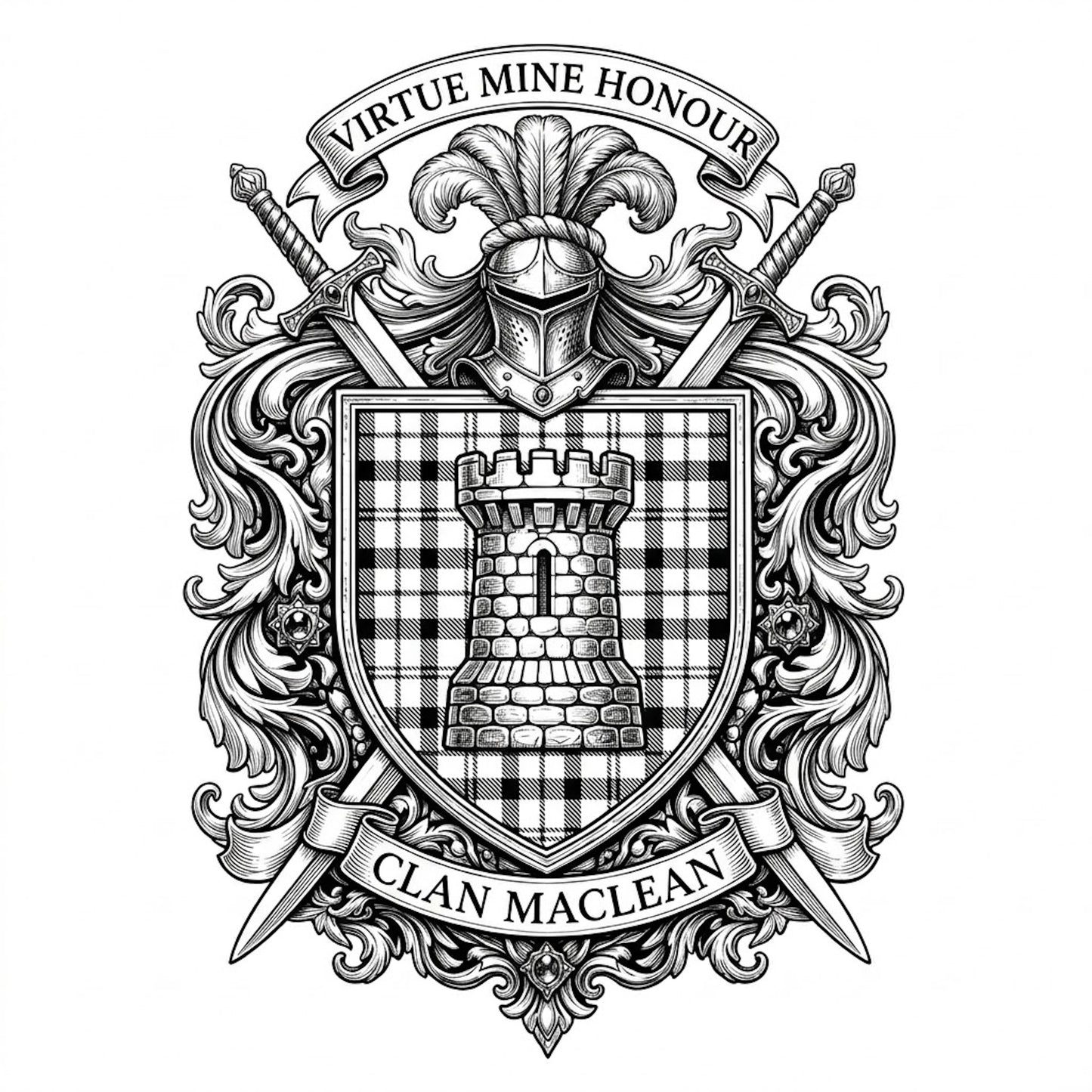
Clan MacLean Crest
Clan MacLean Crest
Regular price
$4.99 CAD
Regular price
Sale price
$4.99 CAD
Couldn't load pickup availability
Every heritage crest is delivered instantly as a high-resolution digital bundle. You will receive three premium file formats tailored for any project:
- Color PNG: Perfect for digital display, standard printing, and framing.
- Black & White PNG: Ideal for elegant family stationery, embossing, or minimalist designs.
- Professional SVG: A fully scalable vector file perfect for large-scale printing, laser engraving, and custom merchandise.
The earliest origins of MacLean heraldry trace back to the clan’s 13th-century progenitor, a fearsome Celtic warrior named Gilleathain na Tuaighe, or Gillean of the Battle-Axe. According to clan legend, Gillean was on a stag hunt on the slopes of Ben Talla on the Isle of Mull when a dense fog rolled in, separating him from his hunting party. He wandered blindly for three days. On the fourth day, utterly exhausted, he crept under a cranberry or laurel bush, fixed the handle of his battle-axe firmly in the earth, and fell into a deep sleep. His companions finally found him because the gleaming head of his battle-axe was visible above the foliage.
This legendary event gave birth to the oldest and most universal symbol of the clan: a battle-axe crossed with branches of laurel and cypress. In this ancient motif, the laurel branch symbolises victory and life, while the cypress branch—historically associated with Roman burial rites—symbolises death and eternal life. Together, they visually represent the clan’s famous binary martial slogan, Bàs no Beatha (Death or Life), establishing a philosophy where only two outcomes were acceptable for a clansman: victory or a noble death. To this day, cadet branches such as the MacLaines of Lochbuie and the MacLeans of Ardgour and Coll continue to use the battle-axe, laurel, and cypress in their crest badges, often accompanied by mottos like Vincere vel Mori (To Conquer or Die) or Altera Merces (A Different Reward).
However, as the clan’s power grew and became more structured, the heraldry of the senior line—the MacLeans of Duart—evolved from the mobile battle-axe to a symbol of stationary, landed power. The primary crest of the MacLean Chief became "a tower embattled Argent" (a silver or white embattled tower). This tower is a direct heraldic representation of the clan's ancestral seat, the formidable Duart Castle. Perched on a high cliff guarding the Sound of Mull, Duart Castle was acquired by the MacLeans in the 14th century following the marriage of Lachlan Lùbanach MacLean to Mary MacDonald, daughter of the Lord of the Isles. The silver tower symbolises purity, integrity, and the steadfast nature of the clan's island fortifications.
When a member of the Duart line wears the clan badge today, they wear this embattled tower encircled by a strap and buckle bearing the Chief's motto: "Virtue Mine Honour." Translating to "Virtue is the mark of my honour," this motto is a sophisticated commitment to moral excellence, standing out amongst Highland mottos which often focus purely on vigilance or aggression. Adopted formally in the 17th century, it served as a unifying rallying cry during skirmishes and a reminder that true nobility is built upon a foundation of virtuous conduct.
Ultimately, the MacLean crest badges—whether displaying the ancient battle-axe of Gillean or the steadfast tower of Duart—are far more than decorative accessories. They are living links to a proud Hebridean history, embodying the survival, loyalty, and enduring honour of the Clan MacLean.